Showing posts with label Temperament. Show all posts

Monday, September 26, 2011

Podcast #21: When Temperaments Clash!

Check out the line up for our latest thrilling episode!

Situation of the Week (Jenn): Mutual Problem-Solving with a Babysitter

Topic: When Temperaments Clash! (begins 13:33)


Q & A: Is it effective for parents to play good cop/bad cop with their kids? If so, why? And if not, what do you think the root of parents playing these roles is? (begins 37:49)

Saturday, July 9, 2011

A Funny Livy Story

(originally posted at Reepicheep's Coracle)

Yesterday, Aaron, Livy, and I had dinner with Jenn, Brendan, Ryan, Morgan, and Sean. When we were getting in the cars to leave, Jenn said, "Have fun in Nashville!" to me. (Aaron and I are doing a super fun getaway together this weekend!) Livy overheard this comment.

L: "Mom, what is Nashville?"

Me: "It's a city in Tennessee. We went there together a couple of times. Remember the place where we saw the Parthenon with that ginormous statue of Athena and went to the Opryland Hotel with the river inside?"

L: "Yes."

Me: "Well, Aaron and I are going there this weekend."

At this point, Livy started to cry. I thought, as you probably do, that Livy was sad because she wasn't going to get to go with us. I was preparing in my head to give a big rousing speech about how everyone needs time alone with people they love, about the time Livy and I spend alone, etc.
L: (Crying loudly.) "Why can't you ever go on vacation while I am at my Dad's house?"

Me: (Thoroughly confused.) "We are. Just Aaron and I are going to Nashville. You will be at your dad's the whole time."

L: (Looking much relieved.) "Oh, good. I just want to stay home forever. We take too many vacations. Let's just stay home from now on, okay?"

I'm posting this story so that my readers can get a better sense of who Livy is. She is, in many ways, the anti-Kelly. I want to go everywhere all the time. And if people do things without me, it takes all my restraint and good principles not to actively wish that they are having a terrible time. All the fun in the world should happen when I am present. :)

Livy, on the other hand, likes a more low-key life. She likes to be at home, to work on her projects, to watch shows she likes, to go to her friends' houses, to sleep in her own bed. And apparently, she couldn't care less if other people are off having fun without her, as long as she is content at home while they do it.

One more piece of evidence for me to use to understand the introverts in my life. Weird folk, but beloved, so I keep on trying. :)

There's no particular reason to post this photo, except it's extreme cuteness. Livy is in the middle, with two of her friends. The kid on the right is Morgan, Jenn's daughter. The one the left is Zara, an awesome-sauce kid from our homeschool co-op, whose fashion sense is a constant source of delight to me. If I was really secure enough to not care what people thought of me, I would dress just like Zara.

Tuesday, August 3, 2010

For Highly Sensitive People (and Those Who Love Them)

(Originally posted at Rational Jenn)

I read a very interesting article the other day, courtesy of a Facebook group of which I'm a member. It's called "Highly Sensitive People--Sounds, Smells, and Sentiments."

Apparently, sensitivity (the temperament trait) is not just social measure (as in, sensitive people get their feelings too easily hurt or lack Teh Social Skillz)--there's physiological evidence that shows that sensitive people (like me and Ryan, and possibly Sean) have more sensitive neurological systems (emphasis in original):


High Sensitivity and Introversion: Introversion is no longer "low sociability."

Modern personality researchers have done hundreds of studies on the personality traits of introversion-extroversion.

Early research treated it as a measure of sociability, later research looked it more generally as a physiological measure. The studies concur that introverts are:

    * More physically sensitive

    * More sensitive to stimuli and stimulants

    * They process information more thoroughly

    * They prefer to reflect before acting

    * More reflective when given feedback

    * More vigilant in discrimination tasks

    * Slower to acquire and forget information due to their deeper processing into memory

Greater sensitivity is found at all levels of the nervous system from sensitivity to pinpricks, to skin conductivity to faster reaction times

And even MORE interesting is this statement (emphasis in original):

Some highly sensitive individuals are still extroverts!

Usually these are people who have grown up in supportive extended families where social interaction was a source of comfort and the family "ran interference" protecting them from over-stimulation and anxiety until they had the skills to manage the world themselves.

They still typically report needing a lot of "down time" to recuperate after social encounters.

So sensitivity and introversion do not necessarily go hand-in-hand, though they often do.

I find this especially fascinating as Ryan seems to have become more extroverted over time. There was a time when I really worried that he'd be painfully shy, that he'd never want to talk to other people--kids or adults (I know), that he wouldn't learn how to interact with others appropriately, that he'd always hide behind my . . . well, I rarely wear skirts, so we'll just say jeans instead.

To add to my concern/distress over this (during his first four years or so), I encountered many, many people who did not (or could not) understand him. Doting grandparents (Ryan is the first grandkid on both sides of the family, and first great-grandkid on 3/4 sides) tried to connect with him, and were rebuffed time and time again. It upset them and confused them, I think.

They wanted desperately to play with him and talk to him and touch him--he wanted none of those things from anyone except me and Brendan. Many of our family and friends tried erroneously to "push" themselves into his space and his life, as if forcing the issue with him would make it happen. It did not, and in fact, made things more stressful for Ryan, for me and Brendan, and for them.

It wasn't just noise or touch either. He'd cry when he heard slow, sad songs. The first time I noticed this, he was less than a year old. Later, the teacher of our mommy-and-me music class noted that he cried any time he heard a song in a minor key (and it's still true today--he won't listen to anything in a minor key, especially if it's slow). It took him forever to warm up in a new situation--he preferred to observe and observe and observe, often not joining in a playdate at all, or not until the very end. It took him--and my fellow homeschooling moms at co-op will attest to this--MONTHS before he would confidently go into chess class without me.

A few people believed Ryan's reluctance to be touched, his amazing intolerance to loud noises and weird textures, his refusal to play with toys that flashed bright lights or made loud noises, the fact that he really didn't enjoy Day Out with Thomas (heaven-on-earth for most 3-4 year old boys) the one time Brendan took him . . . all of these things and more . . . led a few people to believe we were "sheltering" and "overprotective" and "controlling." Sigh.

So yes, especially in the first 4, maybe 5 years of his life, Ryan was on the track toward introvertedness (introversion?). But that's changed, and I think at least in part, that change has come about because Brendan and I have taken especial care to respect his sensitivity. His sensitivity is CHALLENGING. Ryan is not an easy kid in many ways, and yes, it's seriously trying at times, to have a kid "who is old enough to know better" freaking out at strange lights or sad music.

But we have taken care to send him the message: "Hey, this is a part of who you are. It makes you a neat person. We know that sometimes your sensitivity makes things hard to deal with, and it's our job to help you manage your sensitivities in an appropriate, rights-respecting manner."

What has this meant? It meant that we left "Touch a Truck," a super-fun event in the next town over where all kinds of peopleguys and their peopleguy equipment are parked in a big parking lot for everyone to go and touch and climb into and try out. Sounds like a perfect event for Ryan, no? It's beyond loud, all those sirens going off, and horns. Lights, too. It was overwhelming and horrifying to him, so we left.

It has meant that when we had a fun day taking the train into the city with Kelly and Livy (Morgan was a little baby at the time, so Ryan would have been about 3.5), I had to put the baby in the stroller, and hold Ryan on my lap, helping him hold his ears because the noise of the train was too loud. He didn't freak out, but he needed help managing and coping with this overstimulation. Thankfully Morgan didn't seem to care. Livy, as I recall, was climbing all over the place, completely unaware of the "loud" train (I didn't even notice the noise of the train until Ryan got upset).

It's meant that I've interjected myself between Ryan and other kids, and Ryan and other adults (strangers, family, and friends) when Ryan was becoming overwhelmed by invasion-of-space issues, touches, being scooped up without warning. I have helped him learn to say "No thank you. I need some space right now!" and I have said to others "Please put him down." or "He needs my help right now, thanks anyway." I have seen their hurt and confused expressions and I have done those things anyway.

I have cultivated a level of patience with this that I never knew could exist in my character (I am fundamentally impatient), and spent hours talking to him, explaining, teaching him coping skills and words to say, figuring out when to support him and when (and how) to gently tell him that it was time to try something on his own.

I have questioned myself and our parenting, our temperaments and styles, more times than I can count. Should I have forced him to go to chess class without me? Why doesn't he want to go on sleep-overs? Will he ever leave home? Why can't he just deal already?

But he can't, not without help, and I understand that most of all.

So many times I've heard the same thing: someone telling me "You're too sensitive!" or " Stop being so touchy." I couldn't walk down the laundry detergent aisle at the grocery store because the smell was overwhelming and nauseating (I can still hardly stomach it, though I'm a grown up and thus must suck it up cope). Couldn't stand to be touched by people I didn't know. In large noisy crowds, I can barely think or breathe (remind me to tell you about how I'm never ever EVER going to Taste of Chicago ever ever EVER again). I can't stand to have too many noises going on in the background (though having a few kids will help a person learn to get over that to a certain degree).

I need space, a certain measure of quiet, nobody touching me. Dude is just like me. :o)

It's taken me YEARS to get more in touch with my extroverted abilities--and I will be the first to admit I'm not a super-strong introvert. I spent my teens and twenties on purpose hiding from situations that would overwhelm me. I've spent my thirties learning how to go out into the world and cope with situations that overwhelm me. I am definitely happier now that I can cope.

Ryan has matured out of many of his specific sensitivities--or maybe he hasn't matured, but has managed (I hope with our help) to learn how to cope with overwhelming stimuli in a more responsible way. He is still apt to become overwhelmed, hates sad songs and movies, complains more than the others about smells or sounds. He still needs "downtime" after lots of big situations, but nobody meeting him today could call him "shy." He is confident and talkative, and he is managing his sensitivities much better than I could at his age. 

So I hope that Ryan will feel happy that he has learned how to cope, too, happy that we helped him learn to cope, that we were (mostly) patient with his sensitivities and (mostly) understanding. And that introvert or extrovert, I hope he knows we love him more than a little for this wonderfully challenging interesting aspect of his personality.

Friday, June 4, 2010

Podcast #6: The Trader Principle

This week’s topic is The Trader Principle!

  • Situation of the Week (Kelly): Helping a child manage her frustrations
  • Topic: The Trader Principle (begins at 5:51)
  • Q&A: Toothbrushing Tactics (begins at 17:07)


Thanks for listening! This podcast marks the end of our first group of recordings. We made a couple of changes beginning with Podcast #7. I hope the technical changes will not be apparent, or at least improve the listening experience. And next time we’ll have our first question for the Q&A that came to us after we started podcasting. (Click here to get to the podcast site to download it directly.)

Enjoy this week’s podcast, and help us spread the word! As always, send us email at cultivatingthevirtues@gmail.com. We’d love some constructive feedback, and of course, questions for our Q&A or topic suggestions.


Tuesday, April 27, 2010

Podcast #2: Temperament

Here’s the second podcast! Woohoo! (You can click here to go to our podcast website and download it directly.)

The format for this time is:

* Situation of the Week (by Kelly)
* Topic: Temperament (begins around 4:54)
* Q&A (begins around 28:17)

Yes, we went REALLY long on our topic, partly because it’s a favorite one of ours, and partly because we forgot to watch our time! (Chalk that second reason up to our learning curve.) We were much more vigilant in our subsequent recordings, so we hope you won't hold our blathering on against us. :o)

Brendan did an absolutely AMAZING job of editing our podcast! He fixed the extreme left-right-stereo problem (which couldn’t have been avoided for the first podcast due to some of the technical problems we had recording the first podcast). But it sounds MUCH better. He also made our music sound fancy, and don’t miss the section with Morgan, Ryan, and Livy, just before the Q&A begins! We know that our sounds are still very poppy (hard P sounds, for instance), but we changed the position of the microphones beginning with the third podcast, so hopefully you’ll find that this is less noticeable beginning next time.

Our plan for now is to release a podcast about once a week, usually on a Monday or Tuesday. So check back next week for Podcast #3!


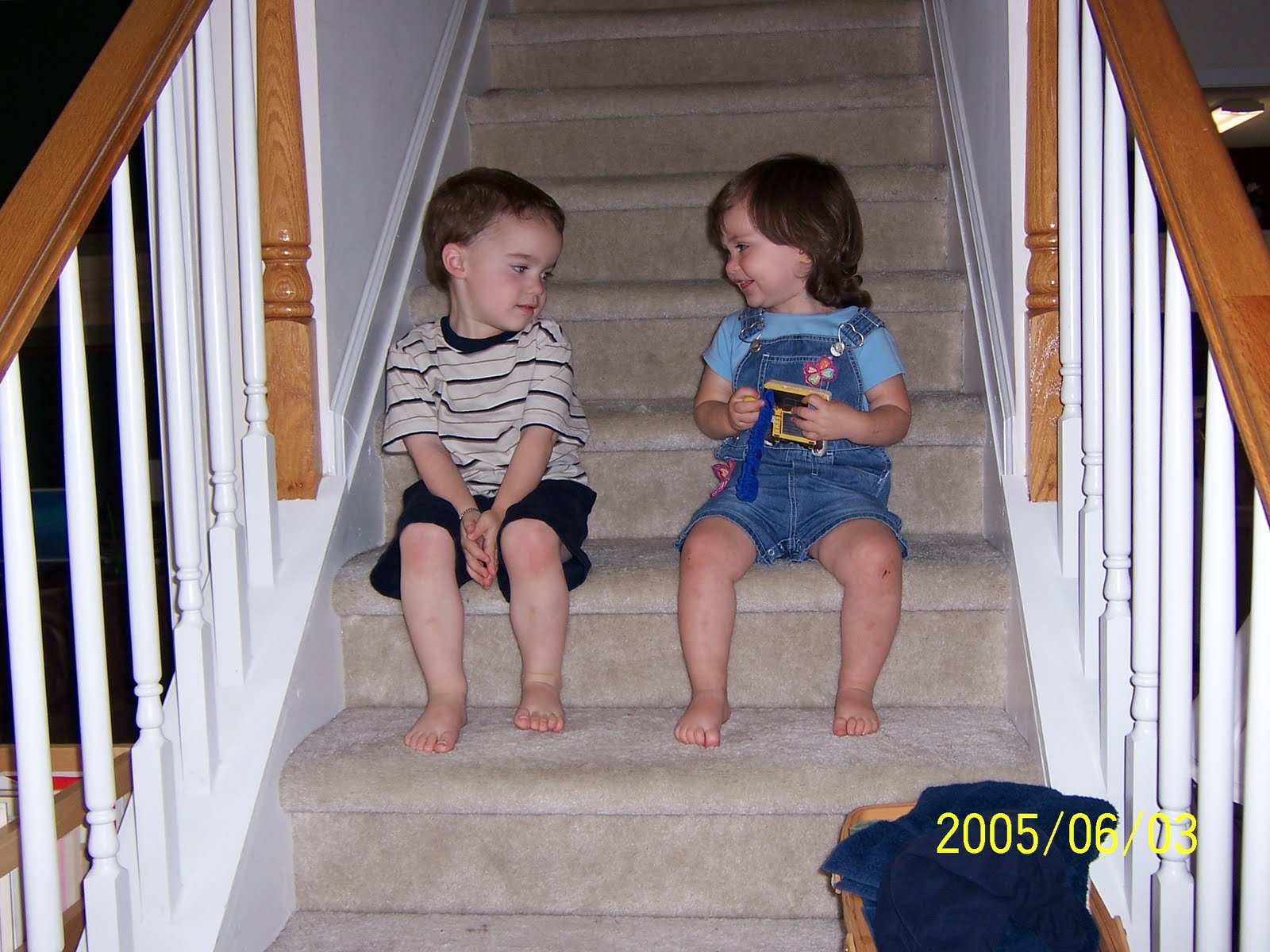
UPDATE: Here's the picture of Ryan and Livy that Kelly mentioned in the podcast. Ryan's about 3, and Livy's about 18 months old.

Tuesday, February 23, 2010

Three Fundamental Rules for Not Raising Brats or Being One Yourself

originally posted at Reepicheep's Coracle

One of my favorite hobbies is getting myself worked up into a frenzy, calling Jenn, and ranting about all the people, ideas, blog posts, news articles, overheard snippets of conversation, and scenes from movies that are WRONG. I have found that whenever I get into an uproar about any parenting issue, my complaints and solutions (of course, I always have the RIGHT one) come down to three rules. If I were going to make a trifold pamplet on parenting, these three rules would be the headers of each section. They apply to parents and kids alike. Here they are, for you edification.

1. Mind your own business.

Ex. 1: Child doesn't want to play soccer/read classic English novel/learn piano/do the thing his parents wish they had done and have now decided to inflict on child. Solution? Parent, mind your own business.

Ex. 2: Child: "Mom, (insert sibling name here) is (insert annyoing but not dangerous activity being reported solely to get sibling in trouble here)." Solution? Child, mind your own business.

2. Get off your butt.

Ex. 1: Child is doing some annoying thing and won't stop when parent says, "Stop doing that annoying thing!" Solution? Get off your butt. Armchair parents, like armchair quarterbacks, never go to the Super Bowl.

Ex. 2: Child yells, "Will you get me some milk?" Solution? Is child sick or injured or 14 months old? Then child needs to get off his butt. Same answer applies for "Mom, I'm hungry," "Mom, I'm cold," "Mom, I can't find my shoes," and "Mom, I spilled water all over the bathroom floor."

3. Suck it up.

Ex. 1: Parent: "My child is intense/sensitive/introverted/extroverted/stubborn/slow to warm up/whatever other temperamental trait annoys you." Solution? Suck it up. You get what you get. Stop whining about it, stop "putting the I wish above the It is," and suck it up.

Ex. 2: Parent is afraid little Johnny may be forever scarred by mom having a life away from Johnny, by finding out that he isn't the smartest or funniest or fastest, by not winning a trophy, by not getting all the things he wanted for Christmas, or by hearing "no." Solution? Johnny will have to suck it up.

I really think that these rules might be the fundamental ones for all human interaction, but so far, I have only applied them to parenting. I'm pretty sure they would work just as well in romance, friendship, and the workplace.

Wednesday, February 10, 2010

Update on my Progress: Connection Before Correction

originally posted at Reepicheep's Coracle

After the positive discipline lecture I attended, I decided to try to use Connection Before Correction to put a stop to some power struggles Livy and I had been having. I felt that we were getting caught up in heated arguments, and I decided to stop and reconnect before we tried to solve whatever problem it was. I also had some nifty strategies for reconnecting in that post; please go read them and use them, so that they won't have been an entire waste of my life. Cause I never got to use them. As it turns out, the power struggles were all my fault, and once I had myself in check, we never got as far as any reconnecting strategies.

I'm still very glad that I did my thinking about the reconnecting before problem solving because it did solve our problem. Just not in the way I thought it would. Turns out WE did not need to reconnect; I needed to reconnect and not start power struggles. When I remembered to take a deep breath and think of how much I love Livy and how she is learning and may not be perfect and that her feelings really count, not just mine, we skipped right into solutions with no trouble from MY temper.

Here's a before and after example.

Before -
Me: Livy, please brush your teeth. It is nearly time to go.
Livy: I'm almost finished with the computer.
Me: (thinking, but not saying) Why can't you ever just get ready when I say!! ARRRRGGGHHHH! You are so slow. That damn computer, I wish I could throw it in the trash!!!!
Me: (in a bossy exasperated way) Livy, I said we had to go now. We can't be late. Go brush your teeth.
Livy: (tears) I don't want to go. Why do you always tell me what to do?
Me: (yelling) GET READY NOW!!!!

After -
Me: Livy, please brush your teeth. It is nearly time to go.
Livy: I'm almost finished with the computer.
Me: (thinking, but not saying) It sucks to be interrupted when you are doing something. I can see why she wouldn't want to jump right up like a trained monkey.
Me: (in a calm and empathetic way) I know you don't want to leave your game, but we will be late if I let you play anymore. Can I help you find a way to pause it so you won't have to start over? Would you like to take your Leapster in the car?
Livy: (still not thrilled) Well, okay. I know how to pause it. I'll play it right when we get home.

So much better. And the difference? MY attitude. Livy is very, very independent. ** She likes to do what she wants to do, she likes to run her own life, and I am glad of that quality. But, that also means that she doesn't like it when I do, legitimately, have to tell her what to do. Seriously, who does like that, except Peter Keating? So, when I do have to boss her, I can at least do it with the attitude of being sorry that I have to and hoping to make it as painless as possible for her.

So connection before correction worked for me, just not in the way I thought it would. It was I, not Livy, who needed to connect to what she is probably thinking, feeling, and wanting, and it was I, who needed to show empathy and love instead of impatience.

**Just as an interesting aside, I thought I would post this picture of Livy at about 8 months old. See me way in the background? That's cause even at 8 months, she didn't want any help. I was to stay out of her way and let her do things. (Just so no one has a heart attack, she didn't actually climb that wall at 8 months. But when she did, she didn't want my help!) That's one more example of how we all get who we get. See Jenn's post for more examples of getting who you get.

Friday, February 5, 2010

The X Factor in Parenting

(Originally posted at Rational Jenn)

Before I get started on this post, which is really just a longish thought that's been roaming around in my head, I have to tell everyone: "WE HAVE NEW FLOORS IN OUR HOUSE!" :o) However, we have very few area rugs, and we spent all of our money on the floors, so I'll be taking up donations at a later time. (Kidding.) (Kinda.)

On to my profound (to me) thought for the moment.

Parenting more than one child has really opened my eyes to something. Sometimes, when something I've done or said has had the desired impact on one of my kids, I think to myself "Hey, that was a good parenting moment right there." Don't we all do that? (And we should!)

Sometimes, though, things that happen as a result of my good and proper parenting actually occur--at least partially--due to the X Factor: The Child.

A quick example. When Ryan was a baby, I went and put him in his crib one night, and he fell asleep. He did that pretty easily and regularly for the most part, and continues to be able to sleep independently without too much parenting. When I only had him, I put this phenomenon down to our excellent parenting strategy. Clearly, we were doing something right. ;)

Enter Morgan. And then Sean. The exact same strategies (plus those important years of experience, which should not be discounted in the least) do not have the same effect on them. Actually, Sean is still very easy, but he's different than Ryan. Morgan has always been hard to get to sleep, and has a difficult time putting herself to sleep. She's getting better, and as with all things Children, goes through phases of progress and backsliding.

But my whole I'm Excellent at Getting my Children to Sleep Theory has been blown out of the water. And this is the Multiple Children Bonus--if I hadn't had more kids, I'd have gone on thinking that I was just the best parent ever at getting kids to sleep.

Each kid is different, and in addition to Excellent Parenting Strategies (which certainly exist), there's each individual child and her temperament AND her free will to take into account.

It works the other way, too, and this can be very comforting. Ryan is nearly eight years old and STILL has trouble sharing toys* and being kind when playing with other kids. We have several Excellent Parenting Strategies we've used (and continue to use) to help him learn that a complete freak-out is not necessary if someone accidentally touches your stuff. As you might imagine, this issue has caused me to worry about him, me, and whether or not I've "done something wrong."

I haven't done anything wrong: Enter Morgan. She is a kind and generous soul. Learning to take turns was never difficult for her. She doesn't mind sharing crayons, or letting someone have a turn. She willingly shares her coloring books with other kids in the waiting room of Taekwondo. She takes turns with her friends and brothers on the computer or with certain toys.

Now, when I was helping her learn those skills and the reasons (again, *) for sharing, I used the same exact strategies I used with Ryan. I modeled taking turns. I helped her find other things to do while she waited for her turn. I shared boxes of crayons with her. I showed her that her friend feels sad if she can't share the crayons. Sometimes, I enforced the sharing. Etc. Etc. Etc.

Here's my point: Morgan got it, years ago. Ryan, three years her senior, STILL has trouble with this concept and struggles to learn these skills. (And yes, it's not only distressing, it's annoying as you-know-what.) So my Excellent Parenting--which is necessary and I do think helpful and I will continue to do--is not the only factor here.

It's those darn kids, and all of their personalities and free will--the X Factor. In many ways, Sean is still emerging, and I don't yet know what I'm dealing with, which keeps things interesting! I can make a few generalizations about his personality, but I can't predict how he might deal with taking turns or potty training or when he'll read or anything like that, because he's just not developed enough for me to have a really good idea yet.

With the third child, I can be sage enough to say that he'll have his own special Seanie difficulties, and he and I will struggle over them. They'll be different Things from Ryan's and Morgan's Things. Because he is a different kid yet again.

I'm not trying to suggest that good parenting is futile or that it's not possible to have objectively good parenting practices. Clearly I think parenting is really, really important, since I do that as a job and think about it all the time and write about it, too. But sometimes I need to remind myself that Parenting isn't all there is to it.


*Sharing in and of itself is not a value for us in the same way it is for most families, and I honestly can't remember if I've written about this topic before. But taking turns with friends/siblings or sharing a box of crayons is a rational skill, and when I talk to Ryan I focus on the rational reasons for doing so, and do not take an altruistic stance on sharing.

Tuesday, February 2, 2010

Acceptance and Parenting: Revisiting An Old Post Cause I Still Haven't Got It Through My Thick Skull

originally posted at Reepicheep's Coracle

This morning I said, "Hey Livy, when I get back from work in an hour and a half, do you want to go out and do something cool? Maybe the zoo or the botanical gardens? Something really fun?" Her answer was, "No, mom. We always go out and do fun stuff. I just want to stay home and play my computer games today."

Well, I was super disappointed. Staying home sucks. Why, oh why, did I get such a stick in the mud child who wants to do boring stuff like computer games when we could be out and about enjoying life? What kind of a weird person likes to stay home? What's wrong with her? What have I done wrong to make her this way?

Now, when I begin to bewail the attributes of my child and question my entire parenting philosophy, it might be time to take a deep breath and practice some acceptance. So, I reframed. I remembered that it is okay for other people (gasp! even my child) to be different from me. I thought of all the cool introverts I know who really do like to stay home and engage in solitary sorts of pursuits, and I remembered that those are the people likely to cure cancer or write the great American novel. I thought about my own selfish needs; perhaps I need to get out more by myself? And then I dug this old post out of the vaults. It was true when I wrote it; it is true now; and reading it again made me feel more relaxed and accepting of who my child is. (It was also a nice plus to see that, though she isn't much more interested, Livy has learned to read since this post.)

Here's the old post, entitled Mustering Up the Serenity to Accept the Things I Cannot (and Should Not) Change:

I've been thinking today about acceptance being a key aspect of good parenting. I think we all have a tendency to want our children to share our favorite personality traits with us, our likes and dislikes, and our talents. It's natural; we want our children to be like us and to be people we have lots in common with. But I think we really must keep this desire in check. We do not get to create people in our own image. Instead, we have to nurture the people we get.

I am a reader, big time. I read all the time - trashy pulp novels, great classics, and everything in between. I find it incredibly hard to relax about Livy's lack of interest in books. She doesn't want to learn to read right now, and she isn't too interested in hearing me read books to her. She enjoys it sometimes, but not like I do. I have to remind myself often that Livy isn't me; she will be her own kind of person. There are good people, happy, rational people, who aren't readers the way that I am.

Another example is how she is a homebody. I love to go out places all the time. In my perfect world, I would only be home long enough to get the basic chores done, and then I would go out again. Livy, on the other hand, would rather stay home most of the day. She likes to play quietly in her room a lot, and that's okay. I have to remind myself that there are lots of happy, rational people who are introverts and enjoy their time at home very much.

I guess what I mean is this: Our children are not ours for molding. They come equipped with talents, likes, and dislikes, and it is not our business as parents to go changing those things. It is only our business to help them learn what they like and dislike and the skills to use THEIR talents to accomplish THEIR goals.

Tuesday, January 26, 2010

Two Things

(Originally posted at Rational Jenn)

My friend Kelly went and got a trampoline, and we are planning to jump on it this afternoon. I told the kids that we'd need to pick up a bit around here before we left, since the mess had reached epic proportions, and I simply didn't want to deal with it when we returned. Originally, I told them that was the only thing I needed before we left for Kelly's.

Turns out, I need two things: some help picking up, and patience. :o)

Upon discovering this about myself, I told them I'd need to amend our agreement--help picking up AND some patience for me would be required before we could leave. The longer this takes, the less time we'll have to spend jumping.

Things that suck away my patience include: having to interrupt my work to make the teasing and shrieking stop, and being Repeaty. I am in control of how often I repeat things, true. So now all I am saying is "I feel Repeaty! My Patience is going away!"

I am getting the most willing, and least arguing, help from them in a very, very long while!

Wednesday, July 29, 2009

Parenting Tool: Reframing Annoying Personality Traits

originally posted at Reepicheep's Coracle

Since Rational Jenn posted her PD: One Word post, I have been thinking about some of my most beloved parenting tools. One of the tools I use most frequently is reframing. I first learned about this wonderful tool in the book Raising Your Spirited Child by Mary Sheedy Kurcinka. The book is one of my favorite parenting books (very compatible with non-punitive discipline), and I think much of the advice is applicable even if you don't end up with a particularly spirited kid.

Basically, the idea is that some of the traits that make children (and adults as well) hard to deal with can be viewed as good qualities when looked at long-term. We all come equipped with different kinds of personality traits, and once we learn to control them, they can be assets to our lives. For instance, the kind of child who has real trouble stopping what he is doing in order to listen to you may turn out to be a Howard Roark with eyes only for his goal. This doesn't let us out of having to teach him how to stop and listen when it is necessary; it is essential to help the child learn to use his personality rationally. The difference is a shift in attitude. Instead of not listening and being awful at transitions, we can choose to think of the child as persistent and focused. It is much easier to work on solutions in this frame of mind.

Here is a list of traits that we generally think of as negative, reframed into more positive attributes:

explosive, over-emotional = powerful emotions, dramatic, expressive
silent, anti-social = introspective, thoughtful
pig-headed, stubborn = determined, persistent
doesn't listen = focused, independent
fearful, a chicken = cautious, an observer
can't sit still, rowdy = physically active, energetic

You get the idea. Once you can identify the positive side to your child's (or partner's or co-worker's) annoying traits, then you are in a good mindset to kindly help her gain control of them. Here are some personal examples:

Livy is a very, very emotional, intense, expressive child. When she was a toddler, she didn't just say "no," like most of the children I know. She screamed it at the top of her lungs right into my face at the smallest provocation. "Would you like some hamburger meat?" "NNNOOOOO!!!!" "We need to leave for the mall now." "NNNOOOOOO!!!!" You can imagine what it was like when she was faced with something that she really really didn't want to do. It was tantrum city. Once, I was trying to put her into her carseat (against her will, as always, cause the child hated the car). She was fighting and screaming, "NNNOOOOOO!!!" I was getting mad, so I took a break to calm down. I conjured up the image of her in the backseat of some boy's car, and I imagined him trying to get her to do something she didn't feel ready for. I imagined how outspoken and expressive and explosive she would be. It helped me to accept that her big big emotions are a part of who she is and will be a wonderful part of who she will become. From that acceptance and reframing mindset, I am able to help her learn to express herself appropriately and to use her intensity as an asset.

Another trait that I try to reframe is Livy's orderliness. Some of you are probably thinking that this is a great trait, but it really conflicts with my way of being spontaneous and playing things by ear and being more free spirited. Lately, she has gotten so clean and orderly and routine and rule-focused, and it is driving me crazy. It bothers her when I change up the order in which I do tasks, when I leave dishes in the sink, when I let the grass grow too tall in the yard. It feels oppressive to me, like she has OCD or something (all you Myers-Brigg J people seem that way to me). So, I try to consciously reframe her behavior. I think of all the successful business people and doctors and engineers and accountants who really need to have these very traits. I try to think of her as orderly and precise, rather than OCD or neurotic. We still have to find solutions to the problem of two very different personalities living together in the same house, but it is easier to see it as a chance for creativity and problem solving when I reframe the traits into more positive ones.

This tool goes along very well with assuming positive intent, but instead of intent, it is assuming a positive side to personality traits. Just as assuming positive intent allows parent and child to move forward to a solution instead of dwelling on what happened, assuming a positive side to a personality trait allows parent and child to move toward solutions and skills that make the trait an asset, instead of dwelling on the traits we wish our children had been born with instead. Unlike the Pygmalion parenting that molds and forms children, using this tool means that we help our children to become the best version of themselves.

Friday, July 10, 2009

Some Days I Struggle

(Originally posted at Rational Jenn)

Merriam-Webster online provides two definitions of the word obstinate:


1 : perversely adhering to an opinion, purpose, or course in spite of reason, arguments, or persuasion <obstinate resistance to change>

2
: not easily subdued, remedied, or removed <obstinate fever>

I have an OBSTINATE little girl.

"Really?"
you may be thinking to yourself, "Not the sweetie-honey-cutie-honey-sweetie!" (That is her Daddy's favorite nickname for her--it's a Cutie Sandwich you see, with honey spread on both sides and sandwiched in between some sweeties. Yes, they are obnoxiously lovey with each other. :o) )

And I am here to tell you YES. Yes, the sweetie-honey-cutie-honey-sweetie. Oh hell yes.

Even many of you who know Miss Morgan in Real Life may not have seen this side of her very often, if at all. She's generally quite easy-going, about 99% of the time. But wow. That other 1% of the time--she is IMMOVABLE. Obstinate. And it's been very hard for me to keep my patience with her lately.

So this morning, I asked myself this question: What do I know about this child? And came up with the following:

  • She is focused, especially inwardly;
  • is very smart;
  • loves to help out;
  • wants to be left alone when she is thinking something over;
  • wants to be left alone when she is sad or angry;
  • has a good sense of humor;
  • is easily overwhelmed by too much information;
  • it's very difficult to break her outside of herself sometimes to get her full attention;
  • yet pays attention when I least expect it;
  • and she communicates a fair amount, but I suspect there is much more going on in her head than she chooses to let on.

Then I tried to find a tool in my Parenting Toolbox that would help me communicate and solve problems more effectively with her.

She doesn't care for role playing, because I think it's too private or intense for her. She doesn't like to discuss problems or solutions for more than a few minutes. She seems to want to get any discussions over with as quickly as possible so she can return to her own thoughts and pursuits. Distraction or changing the subject is out, because she is way too persistent for that.

I think what I need to work on is boiling down MY words (oh so hard to do!) to just the bare essentials. I need to ask her for her ideas, and I need to use more "playful parenting" to take advantage of her sense of humor (now where did I put that book?). And what I mostly need to remember is that she actually can't hear me sometimes and that the best way to get her attention is to touch her and get in her field of vision, and then just wait.

And when she's done being obstinate, she goes right back into Cutie Sandwich mode. I need to remember that, too! :o)

This post has been brought to you by one very frustrating week.

Friday, June 26, 2009

More Problem-Solving with the Kids

(Originally posted at Rational Jenn)

The post about problem-solving I wrote the other day focused on how I spend a good chunk of my time helping the older kids handle their conflicts with each other in a rational, fair way. After I published the post, I had the eye-widening realization that one day, there will be three kids having a conflict with each other! That's a thought that makes me a little weary.

One point I didn't make is how often I really don't have to step in and facilitate their conflict resolution. Sometimes I'll hear them gearing up toward a full-out war of wills and then one of them will say, "I know! What if we . . . ?" and then offer a solution that's fair and that everyone can live with. Or one will express emotion appropriately "I don't LIKE it when you do that!" So I don't always jump in and start helping them with their problem. I will listen a bit and give them a chance to get down to business before I get involved.

Sometimes, my only role is to step in and say "Sounds like a problem here. You two need to work on solving this and if you need my help, please let me know." My intervention serves two purposes: to remind them to focus on solving the problem, and also to stop the escalating emotions (and retributions) in their tracks before someone's feelings really get hurt.

Now that they have quite a bit of practice at this method of problem-solving, and they both understand that problem-solving is one of their responsibilities (not mine), they really are pretty good about managing this stuff on their own. No, not all the time--they're only 7 and 4--but they can and will do it. It really helps now that Morgan is older. When she was younger, and with Sean, I will play the role of the younger party so that the older kid gets negotiation practice, and to model this for the younger child. (And to prevent the younger child from being steamrolled by Ryan the older child.) Sean doesn't get it right now, but that's okay. One day he will begin to understand that this is how we do things and that he can count on me to help him say words and express his feelings. You gotta start sometime, and babyhood is the perfect time to get in the habit, I think.

What's interesting to me is what happens when I use this technique when the kids' friends are over and there's some kind of altercation. Only one of their friends (Livy) is parented in the same way my kids are. She's more used to how we do things and expects to be a part of the problem-solving process. But their other friends are not parented this way. Usually, the first time I sit the kids down to express their feelings, identify the problem and come up with solutions, the other child is very surprised. One of Ryan's friends routinely refuses to participate, which is frustrating for Ryan--and me. Another of his friends is an enthusiastic participant, generating solutions long past the time we agreed on a plan.

Another thing I didn't mention in my post the other is just how often I use this technique to problem-solve the conflicts I have with the kids. It's tough to do, because I am both a party to the conflict and yet still a facilitator, but I think it's been mutually beneficial to everyone. Here are a few examples just from today.


Problem: I was paying bills on the computer and Morgan was interrupting me, despite my asking her repeatedly to give me a few minutes to finish before I could talk to her.

I took my hands off the keyboard, turned around to her and said: "Morgan, I'm feeling frustrated. I've told you several times that I can't talk right now."

Morgan: "But I need you to look at this!" [brandishes a dog picture in my face]

Me: "I know you need me to look at your picture. And I want to. But I'm working right now and I'd like to finish this."

Morgan: "Well, look at it now!"

Me: "We have a problem. I need to look at the computer and my head is filled up with the words and things I'm thinking. I know you need me, but sometimes, since my head is so full of words, it takes me a while to hear the words you are saying. You don't like it when I'm not listening and paying attention to you, and you want to show me your picture. How can we solve this problem?"

Morgan, thinking: "Maybe I can wait until you are done?"

Me: "Yes, that would be helpful to me if you can do that. But if you think I'm taking too long, why don't you put your hand on my knee? That would tell me you are getting impatient and not interrupt my thinking. What do you think, can you do that?"

Morgan: "Okay!"


Problem: I needed everyone to be quiet while I was trying to get the baby to sleep. He had fallen asleep in the car and I explained to R & M before coming inside that I was going to get him to go back to sleep, so we all needed to be q-u-i-e-t. They agreed to this while we were all still in the car (or so I thought). Once inside though, they began pestering me with questions (disturbing the baby); ignoring my hand gestures for them to be quiet (disturbing the baby); necessitating a need for me to speak and remind them to be quiet (disturbing the baby). All of which of course, disturbed the baby who stopped nursing, sat up, and was ready to play! Hmph.

Me: "You guys, I need your attention because I have something important to say."
[Waited for attention.]

Me: "I'm feeling pretty mad right now. You both agreed to be quiet while I was getting Sean to go to sleep. Then you were both talking loudly and trying to talk to me. I kept waving at you to remind you to be quiet, then I whispered and reminded you to be quiet. You kept talking loudly. Then I spoke louder to remind you to be quiet. Then Sean woke up, because we were all talking and we disturbed him. Now he's awake and I'm upset."

Ryan & Morgan: "Sorry, Mom." "Yeah. Sorry."

Me: "Thanks for telling me you're sorry. That helps me feel a little better. But I'm still feeling mad. We have a problem. I thought we had agreed for everyone to be quiet. But then you guys weren't quiet. What can we do next time this happens?"

Morgan: "We'll be quiet."

Me: "Well I know you will try to be quiet, but I need for something different to happen next time so that Sean will actually get the quiet he needs. Should I take him upstairs maybe and get him back to sleep up in my room instead of the family room?"

Morgan: "Yes."

Ryan: "Well I have an idea. Maybe you could do a signal to tell us to be quiet."

Me: "That's an idea. What if I held up my hand like this [held up hand in HALT position]? Would that let you know what I need?"

Both: "Yes!"

Me: "Well, that's something I think I can do. Let's try it."

[We practiced a couple of times.]

Me: "So is this our agreement? Next time you guys are being loud and I need you to be quiet for Sean, but I can't talk, I'll hold up my hand [gestured] like this and you guys will be quiet?"

Both: "Okay, we'll be quiet."

Me: "Okay. Sounds like we have a good plan for next time."

And you know what? Even though I was holding a wide-awake baby while I engaged in this conversation with R & M, and even though I really was very irritated that they had woken up the baby despite our original agreement, the process of talking through this problem and coming up with a solution actually helped my anger dissipate. By the end of it, I wasn't feeling that mad, set Sean down, and went ahead and did something else.

And also--I've held up my hand to both kids several times during the writing of this post (since Sean is asleep on my lap), and they both hushed! It's important to remember that anyone--kids and grownups alike--will be more likely to go along with a plan that they had some input into. I really need to remember that!

We even used our HALT! solution for a related problem that occurred.


Problem: I'm working on my computer (writing the beginning part of this post, when Sean was awake and playing elsewhere) and Ryan wants to tell me everything he knows about cobras. Seriously.

Me: "Ryan, can you stop talking for a second so I can tell you something?"

He paused (but possibly only because he needed air).

Me: "Do you see how I'm sitting here in front of my computer and how my fingers are typing?"

Ryan: "Yes."

Me: "Do you know what I'm doing?"

Ryan: "Well, you're working, aren't you?"

Me: "Yes. I'm working and thinking some thoughts and doing my writing. You want to tell me about cobras, and I'd really like to listen, but when I'm working, I can't really listen all the way. Also, I feel irritated when my work is interrupted. So I have a problem here. Any ideas?"

Ryan: "Well, I can wait to tell you about cobras."

Me: "I appreciate that. I really do want to hear what you have to say. Is there a way I can let you know when you're interrupting me, to let you know that I need you to wait a second for me to finish my thought?"

Ryan: "I know! Why don't you use the same hand thing [does HALT gesture] that you're going to use when we're making too much noise for Sean?"

Me: "Oh, okay! I can do that. I'll hold up my hand like this [demonstrating] and you'll know that you should be quiet until I can pause my writing, right?"

Ryan: "Right."

And that was that!


You know, I learned many of these skills back when I had a real job. I managed people; I worked on product development teams; I facilitated performance improvement teams. These are the same exact skills, only applied in a slightly different context--with my kids. I have to make certain allowances for their ages--the words and ideas they can understand and their emotional maturity level, for example--but other than making my words age-appropriate and having to deal with some inappropriate behavior, I am doing the same thing: I'm speaking respectfully, soliciting their input, restating the problem, restating the agreement.

In situations where I am vested in getting a problem solved (because I'm one of the people who has the problem), it's even more difficult for me to resist the temptation to Parent by
Authority. Because there is a small part of me--it's still there, lurking in my brain--that believes that they are "just children" and they really need to just do what I say already, to obey me.

But when I've parented in that manner: "You need to do XYZ now!" (and I do it still, I'm sorry to say), the problem doesn't really truly get solved. Sure, the kid might scoot and do the thing I need them to, like leave me alone so I can write. But I'm still feeling mad--and now so are they. And really--and this is tough to remember--the child may honestly not have realized they were doing something wrong. So is the problem really solved? Well, kind of. In the short-term. But the "solution" is one-sided, and certainly not ideal.

Or sometimes, the child still won't do what I want and then it becomes a Battle. And if I'm trying to keep Sean asleep, I'm defeated before I've even begun because crying children make a whole bunch more noise than children who want to show me their drawings or talk about cobras. The entire thing devolves into fussing and anger and yelling. And the problem remains.

When I take the time to talk to them about my problems, in the same way I'd talk to Brendan, or the way I insist they talk to each other, then we can usually arrive at some kind of plan for the future, or at least a mutual understanding. Because I have learned that sometimes my assumptions were incorrect. When I give them a chance to tell me what they were thinking or doing and why, I can learn something about that time--and for next time. And vice versa.

When we take the time to talk to each other respectfully (although sometimes somewhat heatedly!), everyone gets an equal chance to say what the problem is. Everyone has a chance to think up solutions. Everyone has a chance to make a plan for what we'll do better next time. We can reach a true, mutually agreed upon, long-term solution. And we can do it as collaborators, not adversaries.

I find that they are much more likely to go along with a plan they participated in creating than one that was dictated to them. And it's easy for me to say "Hey, remember? You agreed to be quieter when I hold up my hand like this." And they whisper "Oh yeah."

Now in order for this problem-solving approach to work, I can't look at the kids as "merely children" who must be corrected or controlled. I have to look at them as whole individual human beings who have valid concerns. Even if I don't necessarily agree with their concerns, I must recognize that they are concerning to the kids, and I need to respect that. When I respect the fact that the kids are individuals, I treat them the same way I'd treat Brendan or my friends.

This doesn't mean that I forget that they are kids--part of keeping Ryan in context means that I am looking at him as an individual human being who happens to be 7 years old. But all too often, I think adults tend to view kids incompletely. They focus only on the child's age. I know--I do it myself. I think: "She's only 4, so I need to make her do XYZ."

Instead, when I remember that the child is more than simply the sum of her years, that she is a human being and therefore:

  • abhors being told what to do;
  • revels when others, especially adults, show her respect as an individual;
  • loves being taken seriously by others (kids and adults);
  • desires to feel efficacious;
  • feels pride in her accomplishments;
  • thrills at being able to accomplish something independently;
  • is still quite young and therefore relies on me for guidance and tips and skills;
  • gets pleasure out of the process of using her mind to solve a problem;
  • that she might make mistakes in judgment;
  • that she might lack knowledge and/or experience that might have led her to a better decision;
  • that she alone thinks her thoughts and feels her emotions;
  • that she wants to be happy, too

--then I know that taking the time to give her tools she can use to solve her own problems (even problems she has with me!) is absolutely the right thing to do.

Friday, May 8, 2009

Mustering Up the Serenity to Accept the Things I Cannot (and Should Not) Change

originally posted at Reepicheep's Coracle

I've been thinking today about acceptance being a key aspect of good parenting. I think we all have a tendency to want our children to share our favorite personality traits with us, our like and dislikes, and our talents. It's natural; we want our children to be like us and to be people we have lots in common with. But I think we really must keep this desire in check. We do not get to create people in our own image. Instead, we have to nurture the people we get.

I am a reader, big time. I read all the time - trashy pulp novels, great classics, and everything in between. I find it incredibly hard to relax about Livy's lack of interest in books. She doesn't want to learn to read right now, and she isn't too interested in hearing me read books to her. She enjoys it sometimes, but not like I do. I have to remind myself often that Livy isn't me; she will be her own kind of person. There are good people, happy, rational people, who aren't readers the way that I am.

Another example is how she is a homebody. I love to go out places all the time. In my perfect world, I would only be home long enough to get the basic chores done, and then I would go out again. Livy, on the other hand, would rather stay home most of the day. She likes to play quietly in her room a lot, and that's okay. I have to remind myself that there are lots of happy, rational people who are introverts and enjoy their time at home very much.

I guess what I mean is this: Our children are not ours for molding. They come equipped with talents, likes, and dislikes, and it is not our business as parents to go changing those things. It is only our business to help them learn what they like and dislike and the skills to use THEIR talents to accomplish THEIR goals.

Thursday, February 26, 2009

Emotions

(Originally posted at Rational Jenn)

From the three-year-old screaming in anger because she was denied her chance to play with the latest video game, to the six-year-old shouting "Woohoo!" at an earsplitting decibel level because he just found that special rock that had gone missing from his collection, to the baby who freaks out every time Mom moves more than three feet away: little kid emotions are anything but little.

And I don't know for sure, but I suspect, that the emotions continue to be big as the kids get older. :o)

One of the greatest benefits I've gained from all of my research into positive discipline is learning some excellent techniques for helping my kids identify and handle their emotions. And even better: I have improved at identifying and handling my own emotions, too.

Everyone has heard of "The Terrible Twos," that developmental stage where a child's Big Emotions emerge in Big Ways and can often be overwhelming for everyone to deal with. As I was contemplating mommyhood, I was very nervous at the thought that I would one day be faced with such a creature, since it was often so difficult for me to handle some of my own big feelings.

And it has been difficult at times. It's really hard to remain calm and collected when someone is freaking out in your face. Or when multiple someones are ganging up on you to make you lose your mind having diametrically opposed issues (that is, the only way to satisfy one person is to disappoint the other). Or when you needed to leave the house 15 minutes ago. Or when you happen to be caught up in your own strong emotions.

I can honestly report that I'm getting better all the time. :o)


Call A Spade A Spade

When the kids were very small, we told them the names of the emotions they were experiencing. This may sound like a "well, duh" kind of thing to do, but I am amazed at how often I have encountered parents who have not done this. Identifying the emotion is the natural first step to belong a child understand and control his emotions.

When someone seems upset, I take a stab at what they might be thinking and say something like: "You seem mad." I learned early on that I would be corrected if my guess was even slightly off.

  • "It's frustrating when you can't break apart those LEGOs."
  • "You're sad because you can't find your special leaf." (True story.)
  • "Wow, you must be so proud of yourself!"

Even with the baby, who as far as I can tell only understands the words milk, kitty, Daddy, and possibly his own name, I am naming his emotions for him. Because one day he will understand what I'm saying and feel the need to correct me.


Listen Actively

Back when I used to have a Real Job (ha ha!), I managed people for a living. (Hmmm....that's actually a lot like my job these days.) I went to a few classes to learn about how to manage people and one thing I found really useful was something called "Active Listening." Oh hey, look! There's a website!

One of the techniques for active listening is to "reflect" or paraphrase what you're hearing in order to empathize and make sure you're understanding everything correctly. Sometimes, it's enough to just know that someone cares adn understands, you know?

Many of the PD books offer the same advice when dealing with kids. I find this works well in combination with the Naming the Emotions ideas, too. Some examples:

  • "You seem so sad. You didn't like it when she pushed you."
  • "I know, it's hard to wait for your turn."
  • "What happy news! You completed your project!"

Ayn Rand noted that emotions are not tools of cognition. In the essay "Philosophical Detective," from Philosophy: Who Needs It, she writes (emphasis added):

An emotion as such tells you nothing about reality, beyond the fact that something makes you feel something.


Active listening--naming the emotion plus reflecting what's happening--is so useful in the moment, because it helps the child connect the big emotion he is experiencing with something in reality. It helps him begin to understand that emotions are not causeless and random; that emotions give a person clues to what is going on inside his own mind and in reality.

When the emotions are strong and overwhelming (as in Meltdown, Fit, Tantrum, Knock Down Drag Out, Spazz, what have you) and the child is out of control, it can be very scary for her. Helping her identify what she's feeling, and why she is feeling it, is an essential part of comforting her. Eventually, she'll be able to do those things for herself and say things to you like:

"ARRRGGGHHH! I'm so frustrated because I can't open the lid to the Ovaltine and BBBLLLEAEAARRRGG!" (Also a true story.)


And while such a statement might begin and end with a scream, it's the middle part that will (hopefully) stick in her maturing brain. By the time she's an adult, she'll maybe be able to just go with the middle part!


Be An Example

Kids are benevolent little parent-stalkers; they are watching your every move so that they can learn how grownups behave. They're trying to figure it all out because they are working so hard to become grownups themselves, so they observe--and imitate. [Insert "Memorable Evil Laugh" here.]

In this area of emotions, being a good example for my kids has been a challenge for me. I never learned good ways to manage my own frustrations and anger. I knew this about myself going in, but it wasn't until I read some great books about how to better communicate with kids that I finally learned some techniques for just how to improve.

These days, I say things like:

"Having my pathway blocked with toys makes me feel frustrated and worried that I might trip and fall!"

Instead of:

"Arrrgghhh! Get these toys out of my way!"


The first way is better because it models the way I'd like my kids to speak; it identifies my emotions accurately (as opposed to appearing as if I'm inexplicably MAD); and it connects the feelings I'm having with something in reality, offering an explanation about why. Again--identify the emotion(s) and the Something in reality that is triggering the emotion.


Know Thy Temperament

I found the book Raising Your Spirited Child by Mary Kurcinka to be so helpful in understanding my kids' temperaments, and my own, too. My friend Kelly suggested this book to me and it has become one of my go-to resources when I'm trying to understand something related to temperament issues. Another resource I refer to often is The Highly Sensitive Child by Elaine Aron, because both Ryan and I are off-the-charts sensitive types. Sensitive in this case is used in the sense of highly observant and HS people tend to be prone to being overwhelmed by external stimuli.

Each of my kids have different personality traits, even though they all came from the same place, which is so interesting to me. Some of those traits were present from birth, although it's easier to identify in hindsight than at the time.

Ryan, as I mentioned, is extremely sensitive and not terribly persistent. Morgan is extremely persistent and incredibly focused on her own inner world. It's still a bit early to tell, but if I had to make some generalizations about Sean's personality, it would be that he's somewhere between Ryan and Morgan on the sensitivity scale, and that he tends toward Big Passionate Feelings with extreme ups and downs (which blows over quickly, thankfully). Ryan is just like me--it's really kind of eerie. Morgan is even more eerily like her father, if you can believe.

Each kid handles emotions differently, and it seems very temperament-driven. When Ryan gets angry, he quickly and easily becomes overwhelmed and needs quite a bit of help calming down. The technique that has worked really well for him has been the Deep Breath Technique. We count "1...2...3..." and then he takes a deep breath. This must often be repeated over and over for minutes at a time. As he's matured, he can identify when he needs a Deep Breath, and can usually just do it himself.

When Morgan feels incredibly angry or sad, she needs to run and hide. If you try to intrude on her space during this hibernation period, she freaks out and you have to start all over again. So I let her curl into a ball in a corner somewhere, and just check on her occasionally until she is calm and ready to talk.

Our friend Livy needs a physical outlet for her big emotions. Once, when throwing a tantrum at my house, she moved from room to room, kicking and flailing her arms, using big motions. I let her have space to do this, but I did ask her to move away from the baby when she was getting a bit too close.

Help the child understand his personality. I don't how old a child must be before he is able to introspect in the same way an adult can, but there are ways a parent can help a child understand aspects of his temperament and encourage introspection. I have said such things as:

  • "You need space when you're feeling sad. I'll give you some space now."
  • "That sad kind of music makes you feel sad--you're noticing the feelings the composer put into the music."
  • "When you have a problem, you never give up--that's persistence."
  • "You always like to do things for yourself. You like being independent."
  • "When you're mad, you like to kick until all of the mads are all kicked out."

Helping the child introspect and understand his personality can help him figure out when his feelings and reality don't match. It's really good practice, being able to identify any errors that might have been made.

A parent often has to tailor their words, responses, and actions to each child's unique personality. I this is especially true when helping them deal with their emotions.


Don't Be Negative

I don't know if this was intentional on my parents' part or not, but somehow I came out of my childhood thinking that Anger is a Bad Thing. It has taken me, oh, until a couple of years ago to truly understand that Anger is a very useful emotion. It tells you: "Hey! There's some kind of injustice here! Figure out what it is and fix it!" Only in a very strong hard-to-ignore kind of way.

For a kid, the most difficult emotions to handle are the so-called "negative" emotions: anger, sadness, frustration. For a parent, those are the hardest ones for me to help my kids handle, too.

My focus has been on helping them understand that these emotions tell you "Something's wrong!" (A more accurate way to view the "negative" part of these negative emotions, I think). However, I try not to convey the impression that I think the emotions themselves are wrong somehow.

One way to do that is to allow the kids to experience the emotions. So many times--and I've caught myself doing this, too--I see parents wanting to fix the problem or distract the child away from the emotion, before the child is ready. And I understand the temptation--those emotions sure are LOUD and you want them to stop already!

Don't get me wrong--sometimes distraction is the thing that's needed. There certainly is a fine line between expressing your emotion and wallowing in it--especially for a kid like Ryan. But I also think that many times, simply holding a crying child and saying "I know, I know" while they work through their emotions can be extremely beneficial. (Is this a sensitive personality thing? I really don't know.) If every sad or mad emotion is met with a "Oh, you're fine! Look, a shiny new toy!" it can confuse the child, make him think that there is something wrong with feeling or expressing certain emotions, or even encourage him to hold those emotions in.

So it takes some thinking about and trial-and-error. Our general procedure is this:

  • Identifying the emotion, with reassurance that it's valid to be feeling that way: "It's okay to be mad/sad. That tells you something is wrong."
  • Letting them know that I'm here to help them solve the problem as soon as they are ready: "When you're done feeling mad, we can solve the problem."
  • Helping them find an appropriate outlet for those big strong feelings (a punching pillow, or a hidey-hole).
  • Once everyone is calm, work on solving the problem.
Another way to avoid inadvertently giving the child the wrong impression that Anger or Sadness is "bad" is to stay with the child while he's experiencing those emotions. When one of my kids is throwing a temper tantrum, as much as I want the noise to stop, or as overwhelmed by the noise I might personally be, I do not banish them from the room until they can get back in control.

Instead, I might say "You're screaming is so loud that others can't talk. Let's go up to your room and I will help you calm down." And then we go through the Deep Breath Ritual (with Ryan). With Morgan, she will usually run and hide, but sometimes needs help regaining control--with her, I have to really play it by ear. I might also say "You're out of control and I know you don't like that feeling. I'm here to help you."

If they are expressing their anger in inappropriate ways, such as throwing toys or hitting at people, I might say "You're mad. It's okay to be mad, but it's not okay to throw toys at me. I'm going to put these toys up until you are calm. Would you like to punch this pillow instead?"

There are times when I've not been physically with my tantrumming child, but those instances are the exception rather than the norm. Sometimes when I am becoming overwhelmed by all of the screaming, or need some space to give the matter some rational thought, or when the kid just couldn't stop hitting, I've stepped away from the situation. It's one of my last-resort coping mechanisms. Usually it doesn't come to that, thankfully.


Honesty

I have one final thought. I encourage my kids to be completely honest about what they are feeling, even when that Huge Feeling of Injustice is directed right at me. Therefore my kids are free to say "I'm mad at you!" and "I HATE it when I have to pick up my toys!" or even "When you yell at me, that's mean!"

Any one of those heated declarations would have gotten me into big trouble as a child. But I think it's okay for them to be able to tell me how they're feeling--happy or sad. And you know, they are often justified.

There's a big difference, of course, between saying "I hate picking up my toys!" and "I hate you!" I haven't had the second statement directed at me very often (but remember, my kids are not yet teenagers), but when that line between "expressing your emotions" and "saying hurtful things because you are mad" gets crossed, it's important to redirect them back to what they are feeling.

One way to do this is to say "It hurts my feelings when you say that you hate me. Try saying 'I don't like it when you do that' instead." Or "You're mad at me--it's okay to be mad at me. It's not okay to call me names. Why don't you try telling me WHY you're mad?" It's very similar to how we handle inappropriate behaviors like hitting, actually, except saying hurtful things falls into the realm of words instead of actions.


There are so many other facets of dealing with emotions, of course. Are there any other areas I should write about, books I should be aware of, things I've missed here? But I think many of the techniques we use will help our kids use their emotions instead of being used by them.

Tuesday, October 7, 2008

Personalities

(Originally posted at Rational Jenn)

Poor Brendan has Jury Duty this week and is quite grumpy about being forced to give up his time and go down to the courthouse and sit. Yesterday he just sat, didn't even get called into a voir dire (that's the term for the process of interviewing potential jurors, isn't i? I'm too lazy to look it up). On the bright side, he gets $25 a day for his trouble.

When I asked him why he didn't email me yesterday--there's wireless access in the juror room at least--he responded that he just didn't think of it. I suggested jokingly that he didn't want any contact with the outside world to remind him of what he was missing. Turns out that's not a joke! That was the reason!

It's funny to me because I'd much rather vent and vent and rant and complain about it. If I was in the jury room today, I'd be emailing everyone in the whole world, Facebooking (which has lately taken a strange hold upon me anyway), blogging, researching, etc. Nope--not for Brendan. He wants to just hibernate somewhere deep inside himself until his ordeal is over for good. Talking about it at length doesn't relieve his stress--it adds to it. I'm just the opposite. I guess it's a good thing that he likes to hear me rant about stuff. :o)

After he left this morning, I got to thinking about how Ryan and Morgan are. Ryan is just like me. Morgan is just like Brendan. Both have been pretty much the same since birth--I think they come out with personalities, or certain tendencies that develop into aspects of their personalities. Don't know what to call it--psychology is not one of my things.

Ryan is ME. Hyper-aware and observant, a tendency toward worry and worst-case-scenarios and perfectionism, easily overwhelmed, takes himself very seriously (so don't joke about him--he hates it), and so absolutely certain of the soundness and logic of his every opinion the he becomes super-irritated when everyone doesn't just agree with him right off. Has lots of leadership/management qualities and tends to dream up amazing adventures for he and his friends to act out. Super big imagination. (Brendan--did I get us right?) Many of these qualities have upsides and downsides, of course. I think before I had kids I would have been hard-pressed to identify too many downsides to my perfect personality, but there's nothing like having a little mirror of yourself to help you see how just a teensy few of your personality quirks might possibly get on the nerves of others!

Morgan is Brendan. Not only does she look just like him, her personality is the same, too. Amazing ability to focus on a task to the exclusion of all else. And I mean ALL. Sharp sense of humor with a big dose of "teasing" in it. Happy-go-lucky for the most part (we often joke that Brendan, like Jerry Seinfeld, is Even Steven) but when she decides to be stubborn, she can out-stubborn Ryan any old day. She's also slow as Christmas and often has little sense of urgency about tasks, especially timed ones, which may develop into Brendan's Time Disability when she gets older. Her musical abilities are more like Brendan's. I'm very naturally musical, but in a technical reading-music kind of way. Brendan is more musical than I am even and can just listen to a song once and play it immediately on the guitar (but doesn't read music). Morgan's more like Brendan.

When Ryan gets angry or overwhelmed, he needs to talk and talk and talk about it in order to feel better. One of the things I learned from the book The Highly Sensitive Child is that it's often helpful to the child to allow him to vent completely in order to be able to let the anger go and focus on solutions. So the best thing you can say is "Tell me more." I need the same thing. If I don't feel like I've had my complete say, then I think about it all day long and imagine all of the things I wished I had said and am still residually angry hours later. But if I vent and rant and get it all out, then I can just let the anger go (assuming a solution to the problem has been reached, of course) and move on with my life. My poor kids though--they don't want to hear Mommy rant and rave ad nauseum, so I have to learn how to get it out without dragging innocent people along with me. (Hence one of the functions of this blog--at least you innocent people are here of your own free will and can leave if you like!)

Now that Morgan is 3.5, some more of Brendan's personality traits are showing up. When Morgan gets upset, she runs and hides and needs to, well, hibernate until she's all better. Any attempt to get her to talk before she's ready makes her lose her mind. She'll talk about it, but only AFTER she's done being angry or sad. Just like how Brendan doesn't want to talk about Jury Duty until it's over.

I think it's very interesting!

We still don't know about Sean yet (jury's still out, ba-dum-bum!). The personality qualities are there, but it's often easier to pinpoint only in retrospect. So far, he's pretty chill, except when he's mad, he's MAD MAD MAD and there doesn't seem to be a fussy, pre-fit, gonna have a freak-out warning period like the others had. He goes from smiling to screaming in about 3 seconds. So that'll be different. The MAD doesn't just disappear either--while he's calming down, he has to fuss and tell you all about it--more like Ryan and me. He'll actually nurse and fuss at me at the same time if I'm too slow (in his opinion) to feed him, just to make sure I know that he's not happy with me. Very funny. And he's the most social of all of my babies--very conversational in a baby kind of fashion, and openly engaging others with batted-eyelash-y smiles. A real charmer. Just don't make him mad. :o)

We were discussing kids this weekend with some friends who are contemplating the prospect. I certainly don't think that having children is some kind of necessary experience that everyone should do. But I'm a different person since I had my kids--and better, I think. Because having a child forces you to clear up your inconsistencies and irrational notions in a hurry, since you need answer difficult questions and are a model for all kinds of behavior that they will repeat right back at you. And when you are faced with your own personality in all its glory on a daily basis, it forces you to introspect and think about and maybe change some habits or behaviors that might not be all that attractive, desirable, or (gulp) rational (I'm only guessing here, since of course I'm perfect and NEVER get on anyone's nerves!). I'm not sure I would have figured some of these things out as quickly if not for the kids. Again--not saying it's the only way to go if you want to make improvements on one's own psyche, but it sure works dramatically!

That's all for now. Brendan, I'd love to hear what you think, but I understand if you don't want to answer from the juror room, I really do!

Friday, May 23, 2008

Famous Last Words

(Originally posted at Rational Jenn)

So, we had something of a playdate here this afternoon, 3 moms, 3 boys, 2 girls. We moms were discussing the various differences between the genders, in particular how quiet it can be when it's just the girls, Morgan and her favorite playmate, L. Our boys can be, well, boisterous. It's just how they do.

Now while this conversation was happening, Morgan and L were in the playroom, which is separated from our family room by french doors, playing peacefully and quietly. Making our point for us, you see.

Ah, how quiet they were! How peaceful! And yes, something of a nice change from the battle cries and body slams of the male offspring. Girls can be so calm and chill, and--dare I say it?--easy. Why, we can actually carry on a conversation when the girls are playing nearby! Can't do that with the boys--they have to be waaaaay outside in the backyard if any meaningful conversation is to be had.

See? This is what you get for tempting the Fates.

Just a few minutes after that, one of the moms--who has 2 of the 3 boys here today--happened to stroll by the playroom only to discover that L was calmly, quietly, and peacefully giving Morgan a haircut.

!!!!!!!

It's not bad, and really with her curls, it's not immediately obvious unless you know where to look.

But how funny! And, you know, nobody ever told them not to cut hair! And L was really trying to help Morgan out, as she had recently been given to understand that Morgan was afraid of getting her hair cut (true) and simply wanted to help Morgan overcome her anxiety. Really, when you put it like that, it was quite sweet of L to support her friend in that way. Morgan has evidently overcome her fear of haircuts, wouldn't you say?

And they really were very quiet, and isn't that the attribute we were praising them for? :o)

Thursday, February 21, 2008

Most Aptly Named Book Ever

(Originally posted at Rational Jenn)

It's titled Your Three Year Old: Friend or Enemy. And I obviously need to read it again. It really 'splains a lot about the inner workings of the brain and emotional turmoil of a typical three year old.

Can you tell that Morgan has decided to hit the "Terrible Threes?" :o) About 6 weeks early.

It's an interesting phenomenon. My favorite part is how they wrestle with Mr. Reality and scream and rage in sheer anger and frustration because, you know, the door won't open in--it only opens out:

Child, screaming in rage: I want to push the door IIINNNNN!

Reasonable Mom: It won't go in.

Child: WHY?!?!?!?

Calm, Emotionally Detached Mom: Because when the door was hung they put the hinges on this side of the door, so if we want to open it from this room, we have to pull it out.

Child: BBBBBLLLLLLAAAAAAAAHHHHHHHHHH!

Really Amazingly Wonderful Mom: silence

Child, thinking up a creative solution to her problem: Move the hinges to the other side of the door!

Mom Who Is Impressed Despite Herself: Sorry, honey, I really can't do that. Why don't you go to the room on the other side and then you can push the door in.

Suddenly Cooperative Child (Warning! Warning! Danger Will Robinson!) goes to the other side of the door: Okay.

Mom Who Should Know Better relaxes for a moment and tries to think of what to make for dinner.

Child: BBBLLLLAAARRRGGGG!

Mom Who Now Feels Stupid: What's the matter, honey?

Child: I want to pull the door OUT!!!!!!

Suddenly Very Tired Mom: But it doesn't pull out from that side. It pushes in. You wanted to push the door in, didn't you?

Child who feels justified and righteous: But not from THIS SIDE!!!!! AARRRRGGHHH!

Mom looks in the liquor cabinet.

Lather, rinse, and repeat a dozen times a day until child approaches 4th birthday.

(Actually, that was a lot of fun to write!)

Both children were absolutely delightful two year olds. When Ryan turned to the Dark Side, I was so sad and shocked. Now I realize that's just how it goes, and I don't take such things so personally. But the thing with subsequent kids is that while you are better prepared for these phases and developmental hurdles, you also remember how trying and exhausting they were when you were going through it with the first kid. I just want to skip to the end--but I know it can't be done.

At least she's cute. :o)